EU AI Act Checklist: 9 Steps for the 2 December 2026 Rules
Two EU AI Act rules apply from 2 December 2026: new bans on AI that generates non-consensual intimate imagery or CSAM, and machine-readable marking for generative AI launched before August 2026. Nine engineering steps, each with a test for when it's done.
Most coverage of the EU's Digital Omnibus said it pushed the AI Act back. It did, for high-risk systems. Two other rules didn't move, and they apply from 2 December 2026.
One bans AI that generates intimate images, video or audio of real people without consent, or child sexual abuse material. The other makes generative AI launched before August mark its output in a machine-readable way. Most EU AI Act checklists give these a single line under dozens of high-risk steps. None of the top five we checked explains how to build the marking.
These rules have teeth. Parliament passed them 423 votes to 57 [8], and breaking the ban can cost up to €35 million or 7% of global turnover. The harm is large too: Graphika counted over 24 million unique visitors to 34 “undressing” sites in one month of 2023 [9].
We built this checklist from the Official Journal text [1], the Commission's Code of Practice [3] and its Article 50 guidelines [4]. It's engineering guidance, so confirm legal calls with counsel.
First, see what applies on 2 December and whether it hits your product. Then learn how both rules work, run the nine steps, and use the closing plan if your deadline is days away.
What Applies on 2 December 2026, and What the Omnibus Didn't Delay
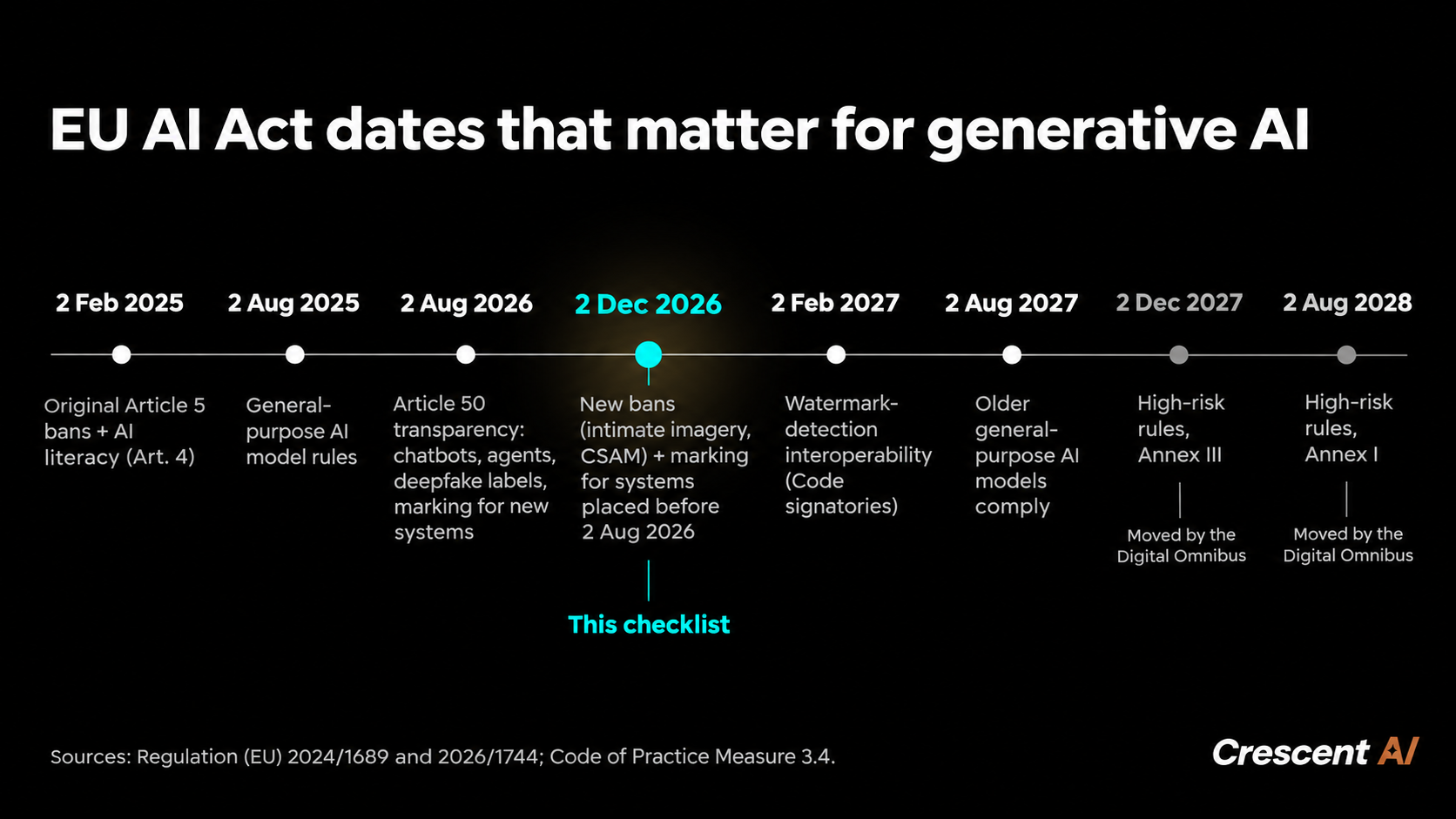
On 2 December 2026, two EU AI Act rules start to apply: new bans on AI that generates non-consensual intimate imagery or child sexual abuse material, and a marking deadline for generative AI placed on the market before 2 August 2026. Both come from Regulation (EU) 2026/1744, the Digital Omnibus on AI, which entered into force on 27 July 2026 and amended the AI Act, Regulation (EU) 2024/1689 [1].
Rule 1: two new prohibitions
Article 5 gains two new points. Point (ba) bans placing on the market, putting into service or using an AI system that generates or manipulates realistic images, video or audio of an identifiable person's intimate parts or sexual activity without that person's “freely-given, specific, informed, unambiguous and explicit consent”. Point (bb) bans the same for child sexual abuse material.
Both apply from 2 December 2026 under the amended Article 113(a). The text has no transition period for systems already on the market [1].
Rule 2: marking for older generative AI
New Article 111(4) says providers of systems “generating synthetic audio, image, video or text content, that have been placed on the market before 2 August 2026 shall take the necessary steps in order to comply with Article 50(2) by 2 December 2026.” Recital 38 calls this “a transitional period of four months” [1].
Systems placed on the market on or after 2 August 2026 had to comply from launch. The grace period covers only marking, not other transparency duties [4].
Already due since 2 August 2026
- Chatbot and agent disclosure (Art. 50(1)). AI agents must disclose both “their artificial nature and the person on whose behalf they are acting” [4].
- Deepfake and public-interest text labels (Art. 50(4)). These are deployer duties.
- AI literacy (Art. 4). It has applied since 2 February 2025. The Omnibus rewrote it but didn't remove it.
Not due yet
High-risk rules apply from 2 December 2027 (Annex III) and 2 August 2028 (Annex I). Older general-purpose AI models have until 2 August 2027. EN 18286, the first harmonised standard, belongs to the high-risk track.
 Open full-size image
What it costs if you miss it
| Breach | Maximum fine | Article |
|---|---|---|
| Article 5 bans | €35 million or 7% of worldwide annual turnover, whichever is higher | Art. 99(3) |
| Article 50 marking and labels | €15 million or 3%, whichever is higher | Art. 99(4)(g) |
| SMEs and start-ups | Each cap is the amount or percentage, whichever is lower | Art. 99(6) |
National market surveillance authorities do most of the enforcing. A Commission spokesperson said the Commission is ready to enforce the ban “from day one”, according to press reports in October [17].
Whether any of this touches you depends on what your product generates.
Does the 2 December Deadline Apply to You?
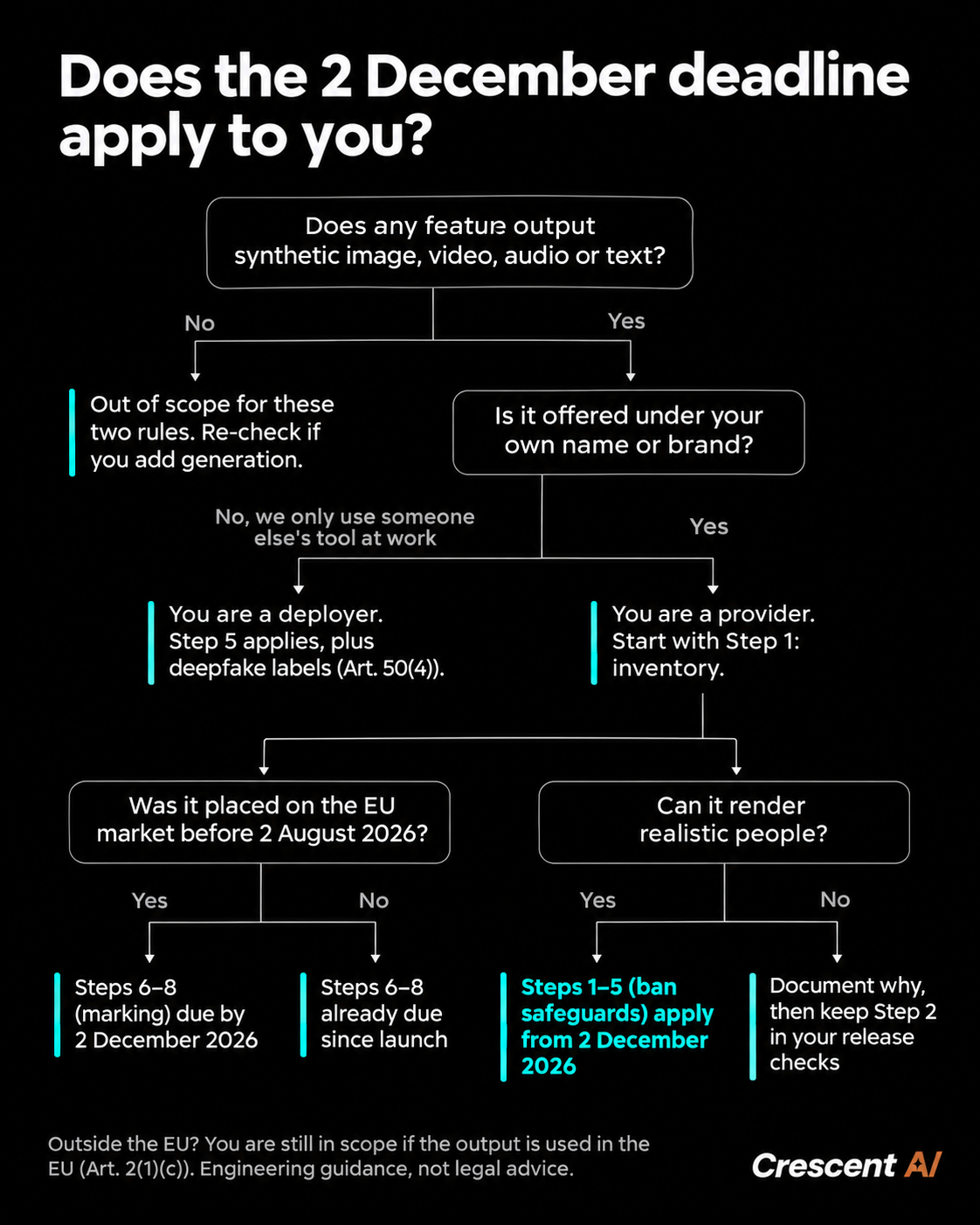
The 2 December rules apply to any company whose product generates images, video, audio or text that reaches people in the EU, and to companies whose staff use such tools at work. Your role decides which steps you own.
You ship a feature that generates images, video, audio or text
You're a provider under Article 50(2). If the feature can render realistic people, the new bans can catch it too. General-purpose AI systems are included.
You put someone else's model under your brand
Article 3(3) defines a provider as anyone who places an AI system on the market “under its own name or trademark, whether for payment or free of charge” [2]. In our reading, a branded product built on a third-party model usually makes you the provider of that system. Confirm it with counsel.
Your staff use a generator at work
You're a deployer. The ban covers deployers who use a system “for the purpose of generating or manipulating such material”. Employees of a deployer don't count as separate deployers [6].
You're outside the EU
You're still in scope if “the output produced by the AI system is used in the Union” (Art. 2(1)(c)) [2].
Usually out of scope
- Purely personal, non-professional use (Art. 2(10)).
- Systems used solely for scientific research (Art. 2(6)).
- Open-source components that aren't themselves an AI system. Open-source AI systems are in scope [4].
 Open full-size image
Find your product
| Product | Steps that apply | Hardest step |
|---|---|---|
| Image or avatar app that renders realistic people | 1–9 | Step 3: proving it refuses edit requests on uploaded photos |
| Voice-cloning or text-to-speech API | 1–4, 6–9 | Step 8: an audio watermark that survives playback and re-recording |
| Long-form marketing copy generator | 1, 2, 6–9 | Step 6: a text watermark, and its limits under paraphrase |
| Agent that writes reports and sends email | 1, 6–9, plus Art. 50(1) disclosure (already due) | Disclosing itself at key steps such as authorisation and reporting |
| Internal engineering-design generator | 1, 7 | Step 7: meeting all three B2B carve-out conditions in writing |
| Company using a third-party image tool for campaigns | 5, plus Art. 50(4) labels | Step 5: getting safeguard evidence from the vendor |
If a row matched, here's how the two rules actually bite.
How the Two Rules Work: The Ban Test and the Two-Layer Mark
The ban turns on whether your safeguards reliably prevent the output. The marking rule turns on whether your output carries a machine-readable mark that a detector can find. Here is how each test works.
The ban test
For providers, Article 5(1a)(a) bans a system “only” where one of two limbs is met [1]:
- Generating such material “is the intended purpose of the AI system”.
- The system's design, training or features make that output “a reasonably foreseeable and reproducible outcome, without requiring significant technical modification”, and the system lacks “reasonable and adequate technical safety measures and other safeguards to reliably prevent” it. That test takes “reasonably foreseeable misuse” into account and includes the ability “to correct observed or reported misuse”.
The second limb is the one most teams fall under. Any general image, video or voice generator that can render realistic people is in play. Whether it's lawful comes down to evidence that your safeguards reliably prevent the output. For open-weight releases, the phrase “without requiring significant technical modification” decides whether capabilities that are easy to switch on count.
Two limits narrow the ban:
- Deployers: the ban applies only to use “for the purpose of” generating such material.
- Edits that aren't “manipulation”: under Article 5(1b), an edit “that does not increase the exposure of any depicted intimate parts or alter the nature of any depicted sexually explicit activities” isn't covered.
Marking doesn't rescue a banned output
The mark
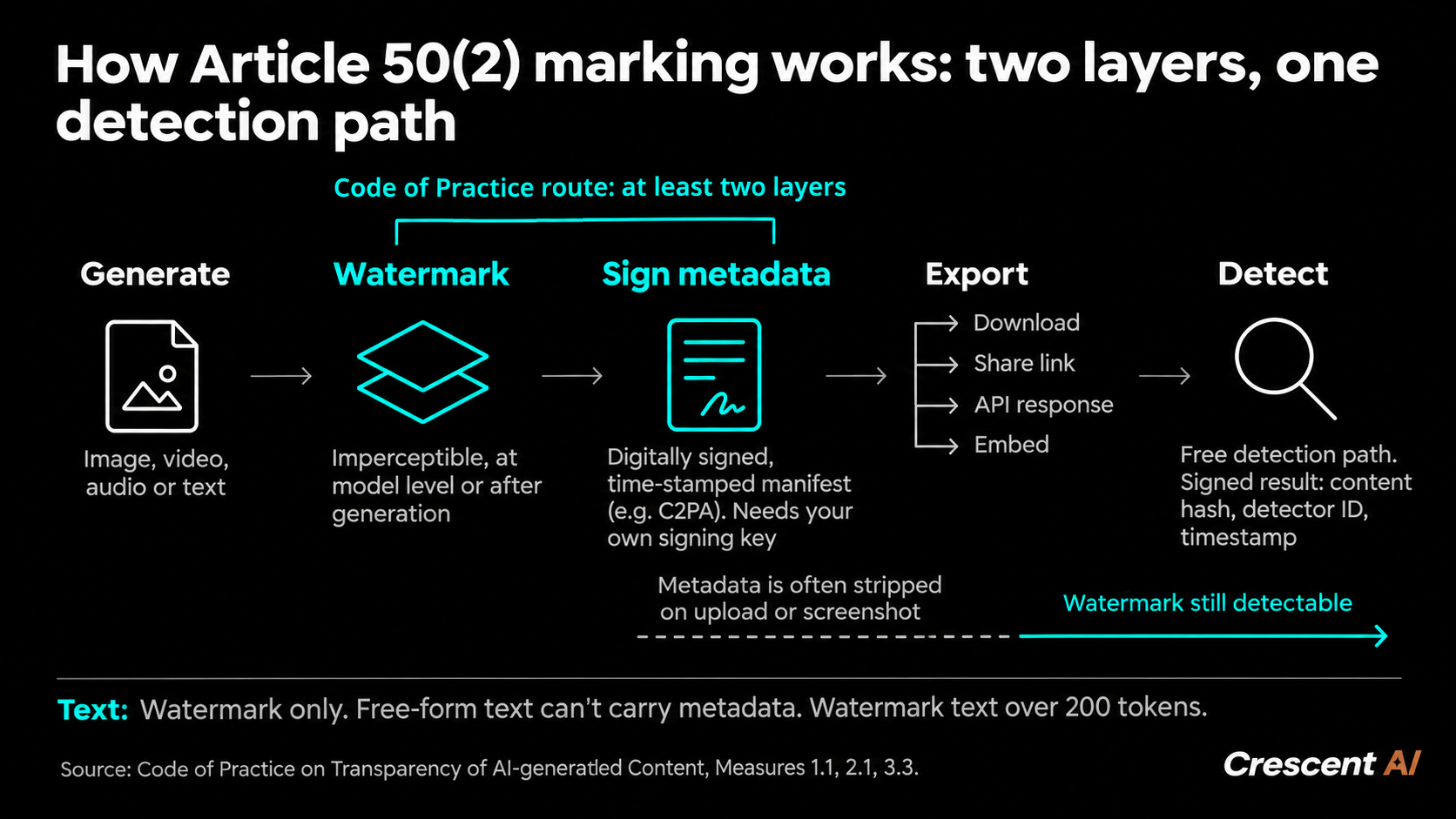
Article 50(2) requires output “marked in a machine-readable format and detectable as artificially generated or manipulated” [2]. The law doesn't name a technology. The Code of Practice does set a route: “at least two layers of machine-readable marking” (Measure 1.1) [3].
- Layer 1: digitally signed, time-stamped metadata (Sub-measure 1.1.1).
- Layer 2: an imperceptible watermark (Sub-measure 1.1.2).
Fingerprinting or logging alone “is not considered sufficient” (Sub-measure 1.1.3).
| Modality | Layers on the Code route | Note |
|---|---|---|
| Image | Signed metadata + watermark | |
| Video | Signed metadata + watermark | |
| Audio | Signed metadata + watermark | |
| Text | Watermark only | “Free-form text cannot transport metadata.” Text over 200 tokens must be watermarked; shorter text counts as “very short text” |
| Generator in a closed physical product | One layer | Only where output can't leave the product |
Your model vendor's watermark helps, but it doesn't cover you. A downstream provider can build on an upstream watermark “without prejudice to the Signatories' own responsibility” (Measure 1.1) [3]. You still have to check that every export path keeps it.
Old output isn't affected. Content generated before 2 August 2026 doesn't need marking after the fact (Guidelines para 154) [4].
A machine-readable mark isn't a visible label. Deployers “cannot simply rely on the machine-readable marking” to meet their deepfake disclosure duty [6]. If you're both provider and deployer, you need both.
 Open full-size image
Here's the full list of what to do, in order.
The EU AI Act Compliance Checklist: 9 Steps
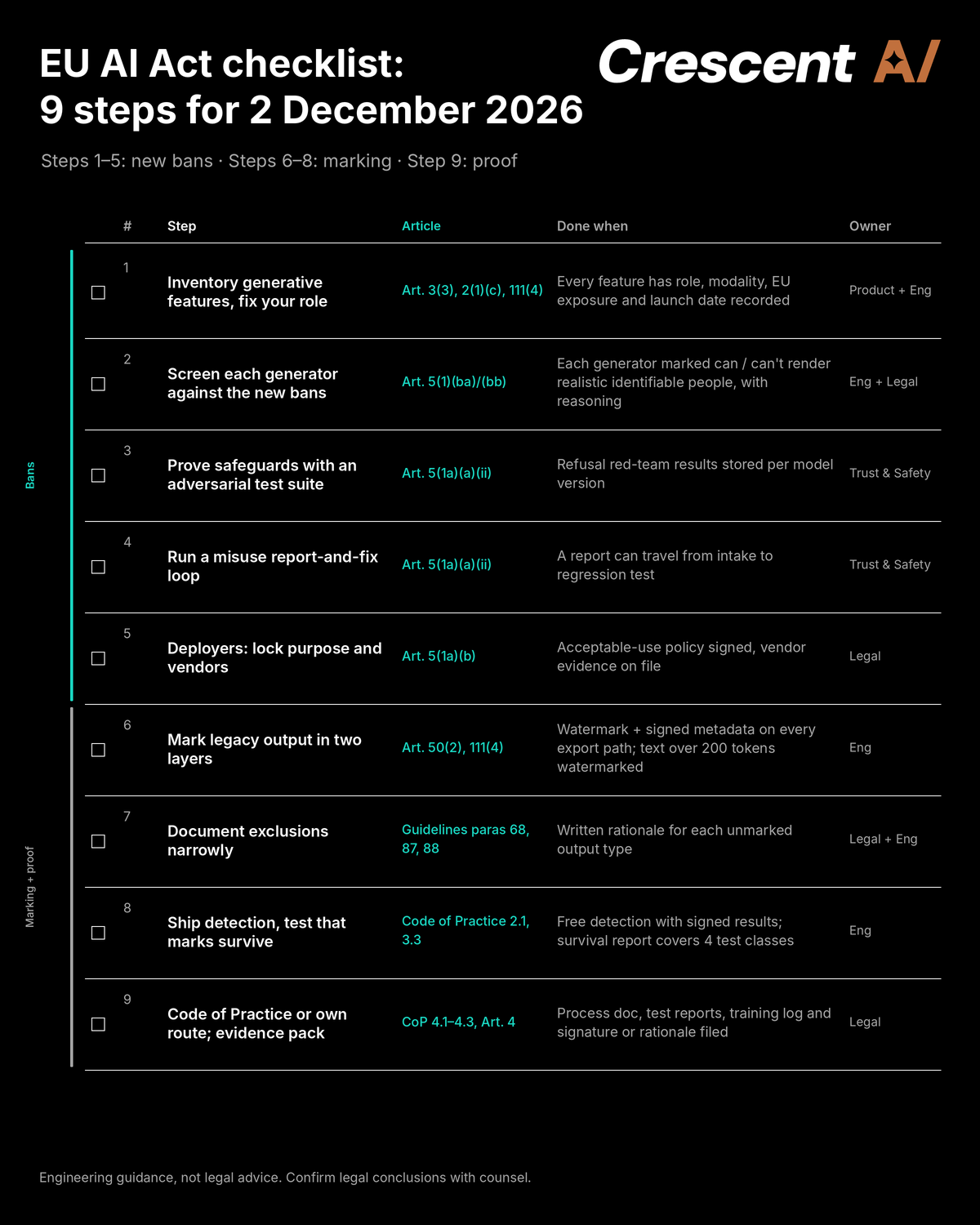
The EU AI Act compliance checklist for 2 December 2026 has nine engineering steps. Steps 1 to 5 handle the bans, Steps 6 to 8 handle marking, and Step 9 covers proof. Each step has a “done when” test, so you know when to move on. Confirm the legal conclusions with counsel.
| # | Step | Article | Done when |
|---|---|---|---|
| 1 | Inventory generative features, fix your role | Art. 3(3), 2(1)(c), 111(4) | Every feature has role, modality, EU exposure and launch date recorded |
| 2 | Screen each generator against the new bans | Art. 5(1)(ba)/(bb), 5(1a), 5(1b) | Each generator has a written “can / can't render realistic identifiable people” call |
| 3 | Prove safeguards with an adversarial test suite | Art. 5(1a)(a)(ii) | Refusal results stored per model version |
| 4 | Run a misuse report-and-fix loop | Art. 5(1a)(a)(ii) | A report can travel from intake to regression test |
| 5 | Deployers: lock purpose and vendors | Art. 5(1a)(b) | Acceptable-use policy signed, vendor evidence on file |
| 6 | Mark legacy output in two layers | Art. 50(2), 111(4); CoP 1.1 | Both layers on every export path; text over 200 tokens watermarked |
| 7 | Document exclusions narrowly | Guidelines paras 68, 87, 88 | A written rationale for each unmarked output type |
| 8 | Ship detection, test that marks survive | CoP 2.1, 3.3, 3.4 | Free detection with signed results; survival report covers 4 test classes |
| 9 | Code of Practice or own route; evidence pack | CoP 4.1–4.3; Art. 4 | Process doc, test reports, training log and signature or rationale filed |
 Open full-size image
Steps 1 to 5 deal with the bans. Start there, because no transition period applies to them.
Steps 1 to 5: Make Sure Your Generators Can't Produce Banned Content
Step 1. Inventory every generative feature and fix your role
List every feature that outputs image, video, audio or text. For each one, record:
- your role (provider or deployer)
- the modality
- whether its output reaches EU users
- the model supplier
- whether it was first placed on the market before 2 August 2026
That last date decides when its marking deadline falls.
Done when: the register exists and every row has an owner.
Step 2. Screen each generator against the new bans
Ask one question per generator: can it produce realistic intimate imagery of an identifiable person, or child sexual abuse material, without significant technical modification? A text-only generator is usually a quick “no” with a written reason. An image, video or voice generator that renders real people is usually a “yes”. That doesn't make it illegal. It means Step 3 decides whether it's lawful.
Done when: each generator has a written yes or no, with the reasoning.
Step 3. Prove your safeguards with an adversarial test suite
The legal test is whether your safeguards “reliably prevent” the output, so you need test results, not a policy statement. Build a red-team suite that covers:
- direct requests
- role-play and jailbreak wrappers
- multi-turn escalation
- edit requests on uploaded photos of real people
- prompts in several languages
Score it with a classifier that a human reviewer has validated, and report the attack success rate. Re-run it on every model or provider change. Our AI red teaming work uses the same structure.
Never generate test material for the CSAM category
Done when: the latest results are stored against the current model version.
Step 4. Run a misuse report-and-fix loop
The statute requires safeguards “to correct observed or reported misuse” [1]. Set up the loop:
- Users can report misuse.
- Someone triages each report.
- A filter or model fix ships.
- Every confirmed case becomes a new regression test in Step 3.
Done when: you can trace one report from intake to regression test, with timestamps.
Step 5. Deployers: lock down purpose and vendors
If your teams use someone else's generator, write an acceptable-use policy that bans using it to generate this material. Ask each vendor for its safeguard test evidence, and put the terms in the contract.
Done when: staff have acknowledged the policy and the vendor evidence is on file.
With the bans covered, the next three steps are about marking.
Steps 6 to 8: Mark and Detect AI Output Under Article 50(2)
Step 6. Mark legacy generators' output in two layers
For each system placed on the market before 2 August 2026, add both layers:
- an imperceptible watermark, at model level or after generation
- signed, time-stamped metadata
Text gets a watermark only, for anything over 200 tokens.
Then check every way output leaves your product: downloads, share links, API responses and embeds. Metadata often disappears on upload or screenshot. The watermark is the layer that has to survive that.
Two more Code commitments go with marking (Measure 1.2) [3]:
- Your terms of use must prohibit removing or tampering with marks.
- Your signing keys need secure handling.
Done when: both layers appear on every export path, confirmed by a test of each path.
Step 7. Document your exclusions narrowly
Outside Article 50(2) (Guidelines para 68) [4]:
- short sequences such as single words, captions, alt-text and UI labels
- source code and configuration files
- machine-to-machine output with no human exposure, such as agent-to-agent messages
- closed-loop intermediate production output “unless they are the final output”
Also excluded: standard editing, such as grammar fixes, translation and format conversion.
The B2B carve-out is narrow (para 87). It excludes “public and consumer-facing AI systems” and needs all three conditions together:
- The output is “strictly technical in nature”.
- It's meant for a limited, pre-defined group of professionals inside the provider and deployer.
- It's not meant to be shared outside the company, with safeguards such as cloud isolation and role-based access.
Ephemeral real-time content, such as in games or VR (para 88), can be exempt only where marking isn't technically feasible and people are told inside the experience.
Done when: every unmarked output type has a one-paragraph rationale that legal has signed off.
Step 8. Ship detection and test that marks survive
Give people a way to check your output, “free of charge”. It can be a public spec, software or an API. Detection for text watermarks may be limited to verified expert users. Results must be downloadable “in a digitally signed format”, with at least a hash of the content, an identifier for the detection solution, and a timestamp (CoP 2.1) [3].
Code signatories also need an interoperability solution for watermark detection by 2 February 2027 (Measure 3.4).
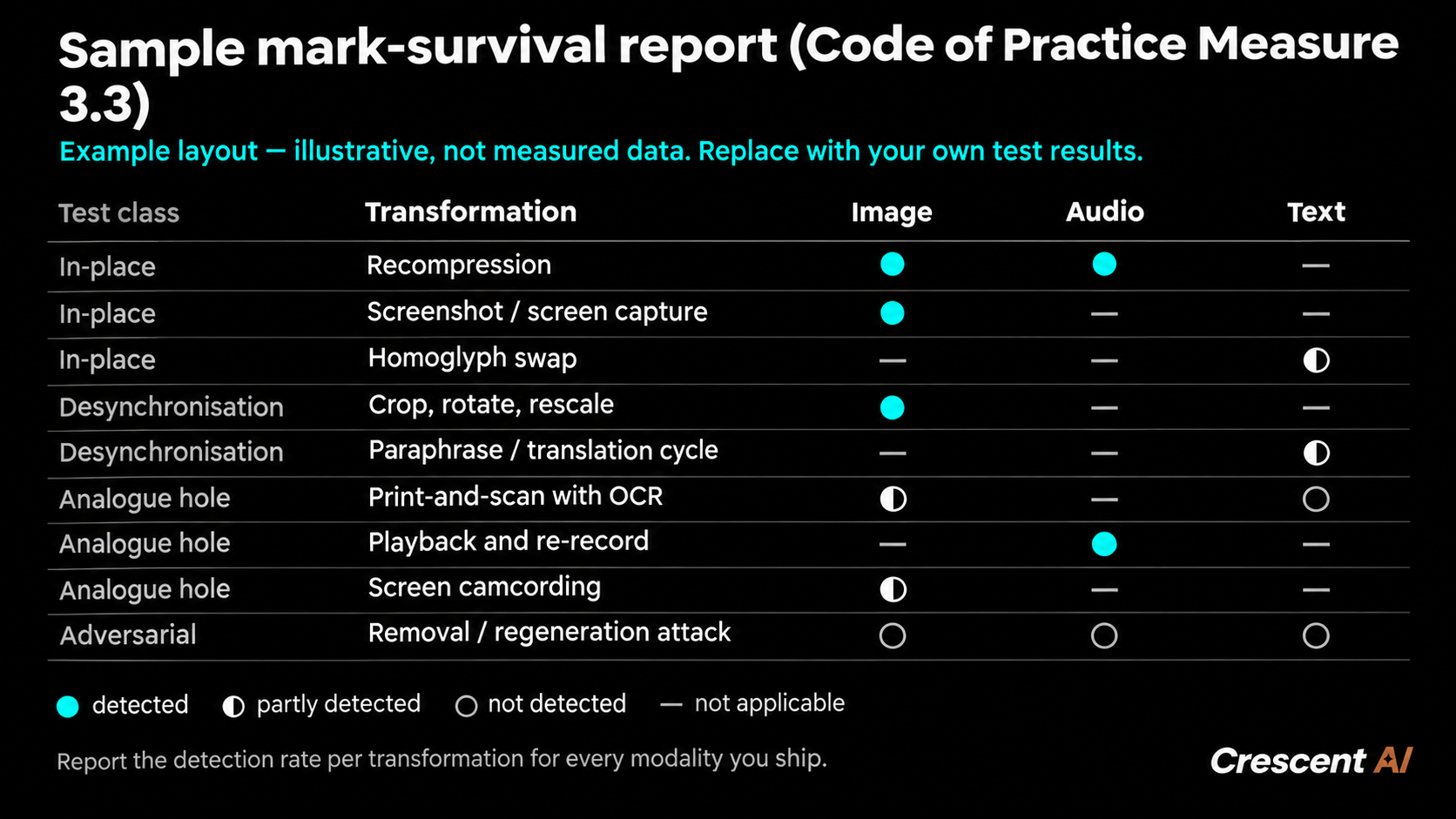
Then test against the four classes in Measure 3.3:
- In-place changes: recompression, screenshots, homoglyph swaps.
- Desynchronisation: cropping, rotation, paraphrasing, translation cycles.
- The analogue hole: print-and-scan with OCR, audio playback and re-recording, screen camcording.
- Adversarial attacks: removal, copying and regeneration.
Report a detection rate per transformation, for every modality you ship. Our AI evaluation practice runs this kind of per-release regression suite.
 Open full-size image
Done when: the survival report covers all four classes for each modality.
Tools for marking, detection and testing
| Layer | Tool | What it does | What to know |
|---|---|---|---|
| Signed metadata | CAI open-source SDK (Rust, Node, browser, Python, mobile) and C2PA Tool [12] | Creates, signs and validates C2PA manifests | “Installing an SDK library does not supply a production signing identity.” You need your own certificate and key handling |
| Image and video watermark | Meta Video Seal (VideoSeal, PixelSeal, ChunkySeal) [13] | Embeds and detects invisible watermarks; MIT license | A research-grade open model, so run your own survival tests |
| Text watermark | SynthID Text in Hugging Face Transformers 4.46+ [14] | Watermarks generated text; ships a detector | Google says confidence drops under heavy rewriting or translation |
| Visible labels | EU icons for AI-generated content [15] | The Commission's official icon set | For Art. 50(4) labels, not the 50(2) mark |
| Safeguard testing | General LLM eval harnesses such as Promptfoo, plus specialist CSAM hash and classifier services | Run adversarial suites per model version | Not built for the AI Act. Use refusal-only probes |
C2PA is one standard that fits the Code's “digitally signed metadata” [11]. The Code itself doesn't name it.
The last step is proving all of this to an authority.
Step 9: Sign the Code of Practice or Prove Your Own Route
Step 9 is a choice: sign the Commission's Code of Practice on Transparency of AI-generated Content, or show that your own measures are adequate. Either way, you keep the same evidence pack.
What signing gives you
The Commission concluded on 8 July that the Code “adequately covers” Articles 50(2), (4) and (5), and the AI Board agreed the next day [7]. About 190 organisations had signed by the end of July 2026 [5]. Signing doesn't prove compliance: “adherence to the code does not constitute conclusive evidence of compliance”.
What not signing costs
You can comply through other means. The Commission says you'll “have to demonstrate that those measures are adequate”, and each market surveillance authority will assess that individually [5]. Non-signatories may also get more requests for information [16].
The evidence pack
Keep these five items in one place:
- A compliance process document (CoP 4.1, proportionate for SMEs).
- Test reports from before launch and regularly after (CoP 4.2). These are your Step 3 and Step 8 results.
- The misuse-loop runbook from Step 4.
- A staff training log (CoP 4.3 and Art. 4).
- Your Code signature, or the rationale for your alternative route.
While you're here, confirm the 2 August 2026 duties are live. If any system falls under Annex III, start the plan for 2 December 2027. Our AI governance and control work covers that longer track.
Done when: the pack exists and someone owns its quarterly refresh.
Before you file it, check it against the mistakes we see most often.
Mistakes to Avoid, Including 4 Things Most Guides Get Wrong
4 things most guides get wrong
"The Omnibus delayed the AI Act."
It moved the high-risk chapter. It also added the December bans and set a fixed end date for legacy marking. [1]
"The Article 50 guidelines are dated 20 July 2026."
The version the Commission publishes is C(2026) 7702 final, dated 5 November 2026. [4]
"AI literacy moved to the Commission."
The amended Article 4(1) still says providers and deployers "shall take measures". It's lighter, but it's still your duty. [1]
"C2PA is required."
The Code never names it. It asks for signed metadata and "relevant established standards or best practices". [3]
6 engineering mistakes
Shipping metadata only
Uploads and screenshots strip it, and the Code route needs two layers.
Treating a visible "AI-generated" line as the Article 50(2) mark
That rule asks for a machine-readable mark. Visible labels fall under Article 50(4).
Assuming your model vendor's watermark covers every export path
Test each path yourself.
Using the B2B carve-out for a consumer feature
Paragraph 87 of the Guidelines excludes consumer-facing systems outright.
Believing a marked output can't be a banned one
Marking and the bans are separate tests.
Testing CSAM refusal by generating content
Use refusal-only probes and hash-matching services instead.
If the deadline is close, here's the order to work in.
If 2 December Is Days Away: What to Do First
The bans carry the top fine tier and have no transition period, so start there. In our view, this order does the most good per day:
- Step 1: list your generators and their launch dates.
- Step 2: screen each one against the bans.
- Step 6: check that legacy generators mark their output.
- Step 3: run the refusal red-team and store the results.
- The rest, in order.
After 2 December
Re-run Step 3 every time you change a model or provider. Refresh the evidence pack each quarter. If you sign the Code, plan for detection interoperability by 2 February 2027.
Need Evidence Before Your Next Release?
Crescent AI runs a fixed-scope readiness review: ban red-teaming, two-layer marking, detection testing and an evidence pack your counsel can review. Engineering work, not legal advice.
Sources
- [1] Regulation (EU) 2026/1744 (Digital Omnibus on AI), Official Journal — EUR-Lex, 8 July 2026
- [2] Regulation (EU) 2024/1689 (AI Act), Official Journal — EUR-Lex
- [3] Code of Practice on Transparency of AI-generated Content (PDF) — European Commission, June 2026
- [4] Guidelines on Article 50, C(2026) 7702 final (PDF) — European Commission, 5 November 2026
- [5] Code of Practice on Transparency of AI-generated Content — European Commission
- [6] Transparency obligations under Article 50 AI Act: FAQ — European Commission
- [7] Commission opinion on the assessment of the Code of Practice — European Commission, July 2026
- [8] AI Act: EP approves simplification measures and "nudifier" app ban — European Parliament, 16 June 2026
- [9] A Revealing Picture — Graphika, December 2023
- [10] Guidelines on transparency obligations for providers and deployers of AI systems — European Commission
- [11] C2PA Technical Specification v2.2 — Coalition for Content Provenance and Authenticity
- [12] CAI open-source SDK — Content Authenticity Initiative
- [13] Video Seal — Meta FAIR, GitHub
- [14] SynthID: tools for watermarking and detecting LLM-generated text — Google AI for Developers
- [15] EU icons for labelling AI-generated content — European Commission
- [16] Code of Practice on Transparency of AI-Generated Content: FAQ — European Commission
- [17] EU bans nudifier apps from December 2 as Commission confirms (press report) — Pasquale Pillitteri, 4 October 2026