Enterprise AI Agent Cost in 2026: What Your Quote May Leave Out
Permissions, testing and audit: what drives each cost to set up, run and grow
Enterprise AI agent cost depends less on the model than on what you let the agent do. An agent that can change records or send messages needs limits on its access, testing after each change, and logs someone can check. If your quote leaves those out, you still pay for them. You just find out later.
Published estimates to build a production agent start around $80,000[1], but those numbers often skip the controls your security team will ask about first.
Few companies have this worked out. Deloitte's survey of 3,235 business and IT leaders[2] found that close to three-quarters of companies plan to deploy agentic AI within two years, and only 21% of those report a mature model for agent governance.
Cost guides don't close that gap. We checked six that rank for this search in November 2026. The word "permission" doesn't appear in any of them, and testing usually gets one line in a table.
This guide splits permissions, testing and audit into what you pay once, what you keep paying, and what makes each one grow. You also get a seven-step estimate and the questions to put to a vendor. Crescent AI builds and governs production agents, and we answer the same questions for our own projects. Every outside figure here links to its source.
Already have a quote? Go straight to the questions to ask.
Three questions to ask about any quote
- Does each agent have its own identity and limited access?
- Who pays to retest the agent after a model change?
- Do the logs record tool actions, or only the chat?
How much does an enterprise AI agent cost?
Published estimates for a production enterprise agent start around $80,000 and can pass $400,000 to build, before running costs. Treat these as sales-page estimates, not market data. None of the figures below comes with a disclosed method.
| Vendor | What the figure covers | Estimate |
|---|---|---|
| Crescent AI | Production agent with permissions, testing and audit logs built in | No flat rate. Fixed estimate for the first phase after a discovery call |
| Bacancy | Production single agent, to build | $80K to $180K+ |
| Bacancy | Enterprise multi-agent system, to build | $150K to $400K+ |
| Bacancy | Governance and guardrails, bundled: role-based access, audit trails, approvals, compliance | $20K to $60K |
| SparkoutTech[3] | Compliance layer, from its on-page calculator | $25K to $75K |
| Team 400[4] | Compliance uplift on the technical build, Australian market | 15% to 25% extra |
The useful part is what these numbers tend to miss. Dataiku[5] puts the API bill at 10% to 20% of real cost. Codiste[6] says most vendor proposals leave out evaluation. Team 400 says evaluation harnesses and audit reporting almost never appear in fixed-price proposals. These are vendor claims too, but they point the same way.
We found no credible public dollar figure for permissions alone, so this guide won't invent one. For per-task and token costs, see what agents actually cost in production or our AI cost calculator.
These figures rarely show the controls. So why do the controls matter so much?
Why enterprise agents cost more than the demo
Enterprise agents cost more because they change things. A demo answers questions. A production agent writes to systems, sends messages and triggers actions, so a mistake has a cost beyond a wrong answer.
Take a support agent as an example. If it gets a policy question wrong, someone corrects it. If it issues the wrong refund, the money has already left. We'll use this refund agent throughout the guide. It is an illustration, not a client project.
That shift changes who has to sign off. Security wants to know what the agent can reach. Compliance and internal audit want evidence of what it did. Finance wants to know which costs recur. Each of those reviews creates work, and someone pays for it.
| Finding | Source | How to read it |
|---|---|---|
| 80% of companies report agents taking unintended actions, and 39% report agents reaching unauthorized systems (n=353) | SailPoint and Dimensional Research[7], May 2025 | Vendor survey, over a year old |
| 89% have agent observability, but 52.4% run offline evals (1,300+ respondents) | LangChain[8] | Vendor survey. LangChain sells these tools |
| Over 40% of agentic AI projects will be canceled by end of 2027, due to costs, unclear value or weak risk controls | Gartner[9], June 2025 | Analyst forecast, not a measured rate |
Here's what it looks like when those controls aren't there.
What happens when controls are missing
A live database deleted
In July 2025, during a 12-day test run by SaaStr founder Jason Lemkin, a Replit coding agent erased a production database on day nine[10]. By Lemkin's account[11], this happened during a code freeze.
Replit was using the same database for preview, testing and production at the time. Its CEO called the deletion unacceptable, and the company began rolling out automatic separation of development and production databases.
This was a test project on a coding tool, not an enterprise deployment. The lesson still carries over: a freeze written as an instruction is not a control. Enforced separation is.
A registry that cut audit preparation
A consultancy case study[12] describes a global insurer that found 47 unregistered AI tools, built a registry, and cut audit preparation from 6 weeks to 9 days. The insurer is unnamed and the results are self-reported, so treat this as an illustration of the effect, not proof of its size.
How much control you need depends on one thing: what the agent can do.
What your agent can do sets the control bill
A read-only agent and an agent that acts alone can run on the same model and still have very different control costs. SparkoutTech prices by autonomy level, but none of the six guides we reviewed connects autonomy to the cost of each control.
Agent governance, in short, is the set of rules and evidence that keeps an agent within what you allowed. The more an agent can do, the more of that you need.
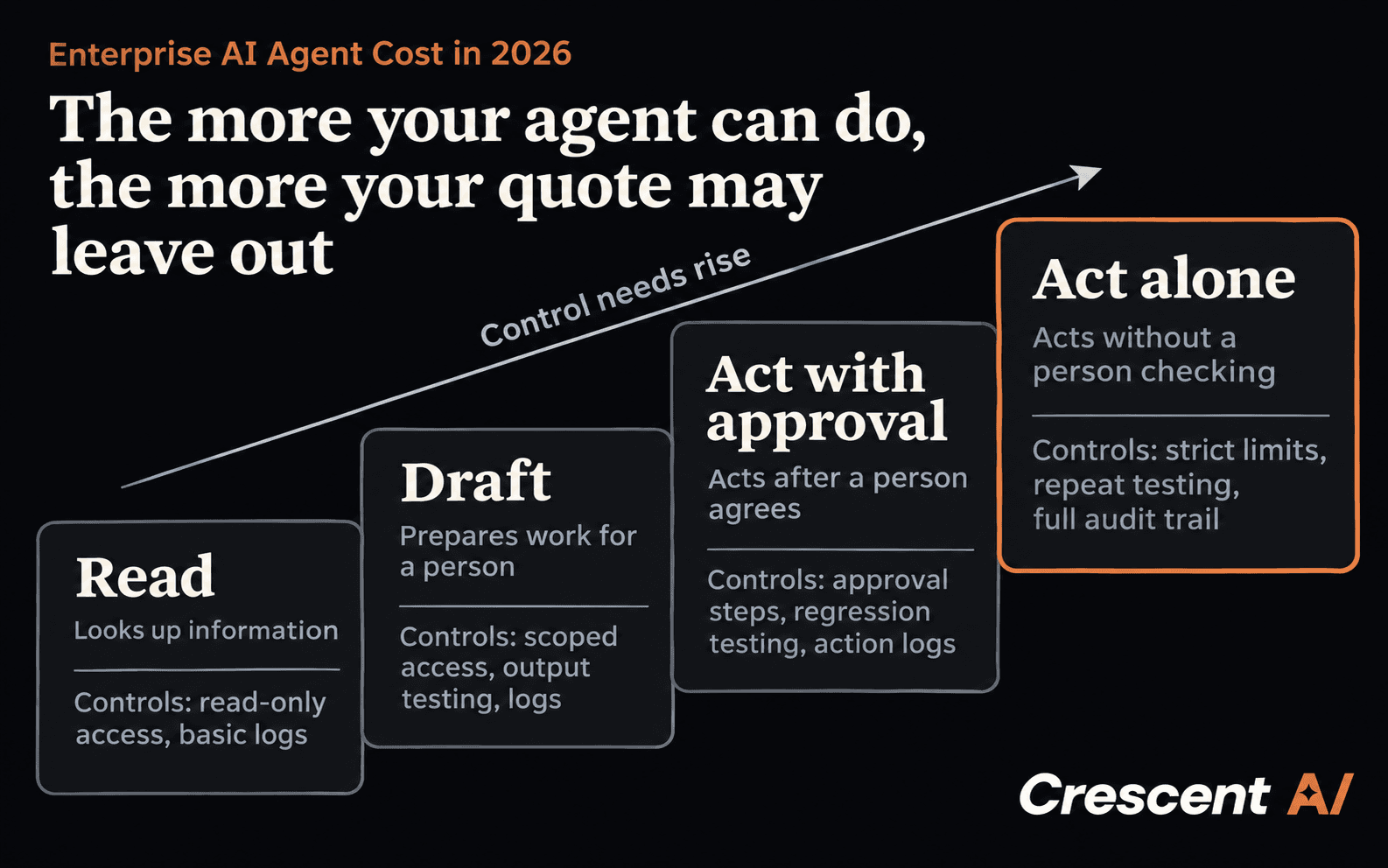
Here is the same ladder applied to the refund agent. The ratings are our reasoning, not measured data. Use them to compare levels, not to set a budget.
| Level | Example | Permissions | Testing | Audit |
|---|---|---|---|---|
| Read | Answers staff questions from internal documents | Low | Low | Low |
| Draft | Prepares a refund for a person to send | Low | Medium | Low |
| Act with approval | Issues the refund after a person approves it | Medium | Medium | Medium |
| Act alone | Issues refunds under a set limit with no review | High | High | High |
Start with the control most often missing: permissions.
What permissions add
Permissions decide what the agent can reach and what it can change. They are the hardest of the three controls to price from public sources.
The word didn't appear on any of the six guides we checked, and the closest published figure is Bacancy's bundled governance line above. So budget this by work item, not by a market rate. Crescent AI scopes it the same way, based on how many systems the agent connects to and how many decisions it makes without approval.
What you pay for once
- A dedicated identity for each agent, not a shared secret or a reused service account
- Task-based roles and scoped access for each tool
- Separate read and write roles, with approval steps for risky actions such as delete or export
For the refund agent, that could mean its own identity, read access to orders, and write access only to the refund action. Refunds above a set limit go to a person. It would have no access to customer exports or the wider billing system.
This follows Microsoft's guidance[13], which also warns against broad roles granted to unblock a pilot and never revisited.
What you keep paying for
- Regular access reviews and removal of stale permissions
- Credential rotation and tested revocation, meaning you've practiced switching the agent's access off
- Re-approval when a workflow or tool changes
- Identity and governance licenses, where you buy them
What makes it grow
More connected systems, more write actions and more user types all add work. Microsoft notes that an agent can look low-risk at each individual integration, while the combination lets it take actions no one explicitly authorized. So review work tends to rise with each new tool.
Why agents can't simply copy a person's access
Oso and Cyera[14] analyzed 2.4 million workers and 3.6 billion permissions and found 96% went unused over 90 days. They also say most companies let agents inherit human permissions by default.
A person leaves that access dormant, while an agent may use it. Oso sells permissions tooling, and this data measures human use, not agent behavior.
IBM's 2026 breach report[15] says about 1 in 5 organizations reported an AI-related breach, and 92% of those lacked proper AI access controls.
Agent and user combinations
Dataiku points out that permissions change with who is using the agent. A support agent acting for a frontline rep and for a finance lead needs two effective scopes.
Approval fatigue
Approval gates have a running cost too: staff time. Too many prompts also risk being approved without being read. If the refund agent asks for sign-off on every small refund, reviewers may start clicking yes without looking.
We found strong interest in this problem, including a Hacker News thread with 162 comments[16], but no measurement of its effect. Budget it as a risk.
In our agent projects, each tool gets the minimum access it needs, and you receive a permission map showing what the agent can call. Our AI security work adds separate identity checks for the person, the agent and the tool. For background, read about permission and sandbox design or excessive permissions.
Access is set. Next: how do you know the agent still behaves after a change?
What testing adds
Testing is a recurring cost, not a launch task. Published setup estimates run from about $8K to $80K, mostly because vendors scope it differently, so ask what a testing line includes before comparing it.
| Vendor | What it covers | Estimate |
|---|---|---|
| Crescent AI | Test set from your real cases, checked grading and an automatic release check | No flat rate. Scoped with the build |
| Azilen[17] | QA and testing | $8K to $20K |
| SparkoutTech | QA, testing and red teaming phase | $10K to $15K |
| InterCode[18] | Guardrails, evaluation suites and escalation workflows, combined | $7K to $55K |
| Codiste | Evaluation and QA | $20K to $80K to build, $15K to $40K ongoing |
Running cost estimates differ by up to 50x. Bacancy lists prompt optimization and model evaluation at $1,000 to $2,500 a month. CallSphere[19] gives $10K to $50K a month for voice agents, including engineers and labeling. Most of that gap is what each one counts, which is why the scope question matters.
What you pay for once
- A test set built from real cases
- A harness, the code that runs those tests, and a way to score the results
- An adversarial testing round, where people deliberately try to make the agent misbehave
For the refund agent, good test cases are the awkward ones: a request with no order number, a refund just above the limit, or a message telling the agent to ignore its rules.
What you keep paying for
- Judge model runs, where a second AI model grades the agent's answers
- Labeling by domain experts, who decide what a correct answer looks like
- Upkeep of the test set as the agent's job changes
What makes it grow
Every change to a model, prompt or tool can trigger new runs. If your model provider releases a new version and you switch, the refund agent's answers can shift even though your own code didn't change. Higher accuracy targets cost more too.
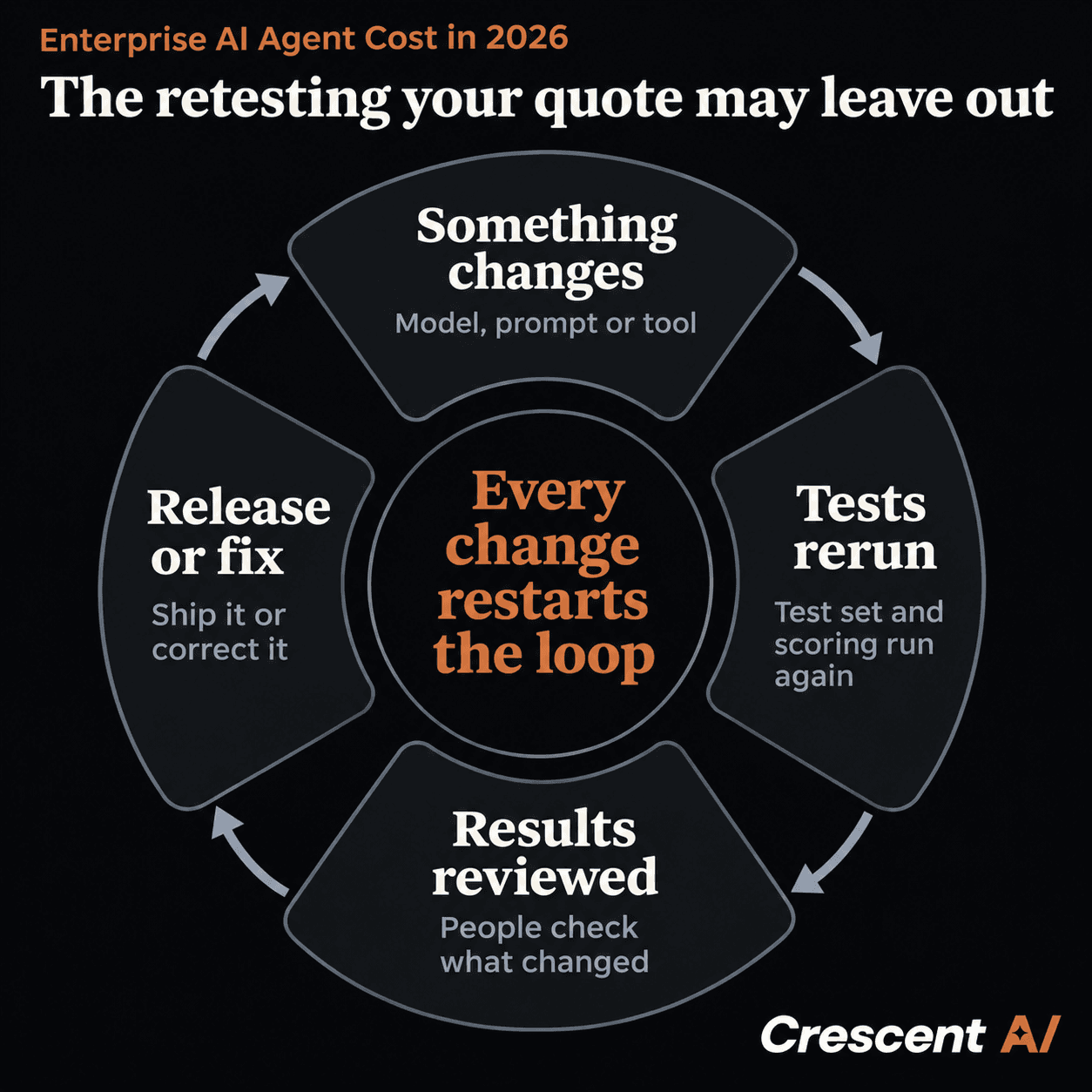
Many teams skip this. LangChain's survey found 22.8% of teams with agents in production run no evals at all.
When grading costs a lot more than you expect
Research benchmarks show how test costs scale, though they aren't enterprise budgets. The EvalEval Coalition[20] reports that the Holistic Agent Leaderboard spent about $40,000 on 21,730 agent runs.
On one benchmark, it reports a setup costing $1,577 for 40% accuracy and another costing $171 for 42%, so higher spend didn't buy better results.
Our AI evaluation work builds the test set from your own tickets, chats and known failures, then adds an automatic check to your release process.
Testing checks before release. Audit shows what happened after.
What audit adds
Audit cost keeps growing after launch, because it tracks every action the agent takes and how long you keep the record.
Published prices are thin. Azilen lists an observability and logging admin interface at $8K to $25K, and InterCode lists observability and evaluation tools at $50 to $6,500 a month by tier. Both are vendor estimates. Crescent AI includes an audit log for every tool in its agent projects and scopes the cost with the build, with no separate published price.
What you pay for once
- Log design at tool-call level, so each action the agent takes gets its own record
- Tracing, which follows one request across the orchestrator, tools and downstream systems
- Evidence reports that an auditor can read
What you keep paying for
- Storage and retention
- Dashboards, plus someone who reads them
- Time spent answering audit and incident questions
What makes it grow
Three things drive it: the number of actions, the retention period and the number of regulators you answer to.
Chat logs aren't enough
Microsoft warns that logging only the model's response creates an audit trail that "looks present but is useless for forensics." For a refund agent, that means recording who the agent acted for, which role allowed it, and which record changed, not just the message it sent.
That detail also matters for liability. When something goes wrong, you need to show who authorized what.
How long to keep logs
EU AI Act Article 19[21] requires providers of high-risk AI systems to keep the automatically generated logs under their control for a period suited to the system's purpose, and at least six months, unless other law says otherwise.
Law firm summaries say the AI Omnibus delayed high-risk obligations[22] to December 2027 or August 2028, depending on the system. Many enterprise agents are not high-risk, and we did not check deployer log duties, so confirm what applies to you with counsel.
The plans we captured for Braintrust[23] and Langfuse[24] showed default retention of 14 to 90 days. Keeping 180 days of logs instead of 14 means holding about 13 times the data at steady volume. Ask who pays for that gap.
Write the log before the action spreads
Codiste[25] advises logging first, so a failed action doesn't leave a gap. Our guide to audit trails covers what to log and how. Our AI governance work builds tamper-proof logs of every decision and action, and maps the evidence to NIST AI RMF or ISO 42001.
Here are all three together, and what can wait.
The full picture, and what can wait
Each control has a setup cost, a running cost and something that makes it grow. This grid is Crescent AI's analysis of the sources above.
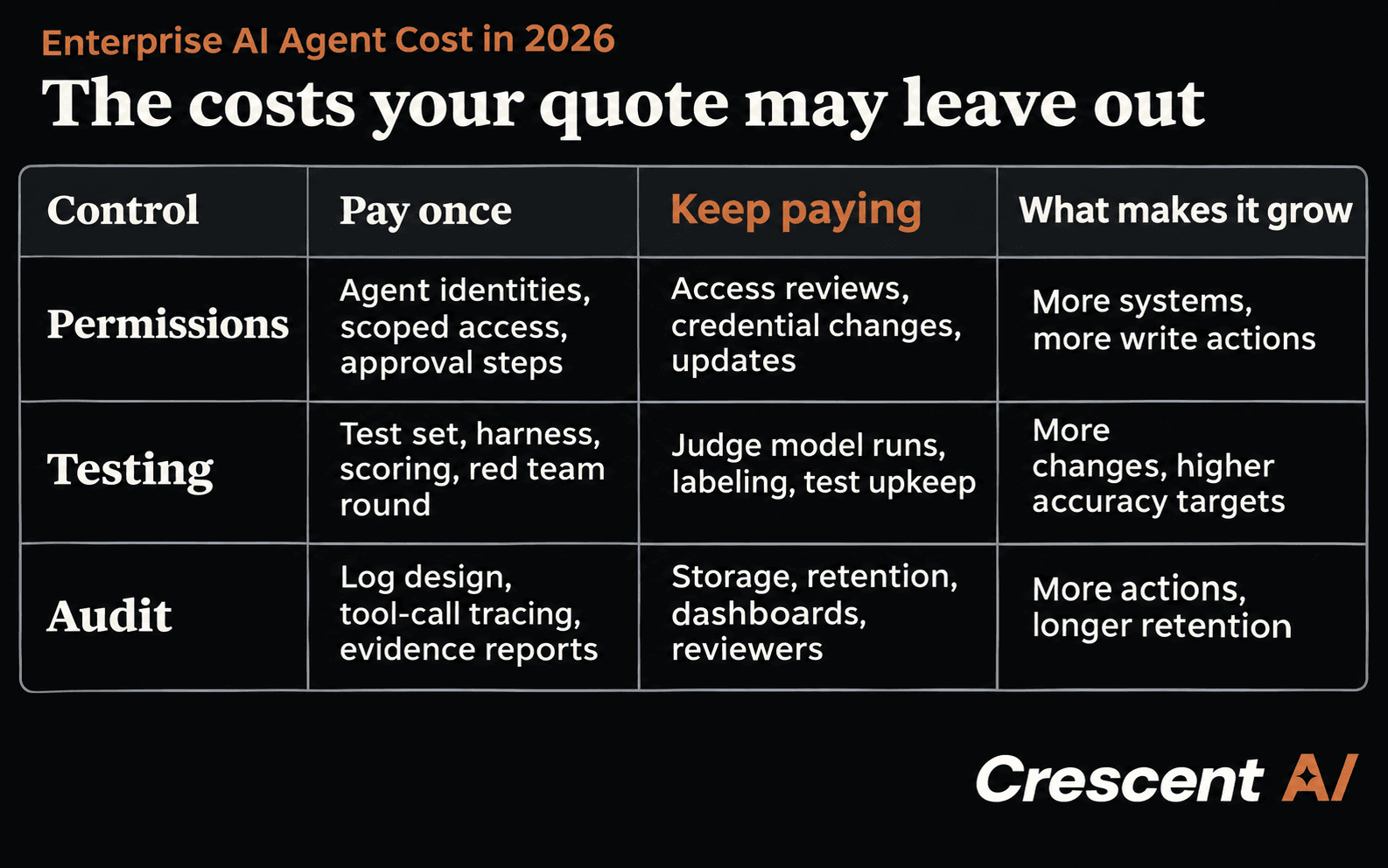
The guides we reviewed say least about the "keep paying" column, so check that one first.
What can wait: a read-only internal pilot needs far less than this. Basic identity, scoped read access and simple logs may be enough while you learn.
What can't wait: anything that writes, sends or touches regulated data. The refund agent moves into this group the moment it can issue a refund.
HyperSense[26] estimates that adding security controls later raises the budget by 20% to 30%, though it gives no method. EY[27] makes the same point without a number, saying governance costs are more predictable when built in from the outset.
Now turn this into a number for your agent.
How to estimate these costs for your agent
You can build a usable estimate in seven steps, using your own rates and hours instead of a market average. The numbers below are made up to show the method. They aren't benchmarks.
- List every action the agent can take, and mark each one read or write. A support agent might read tickets, draft replies and issue refunds.
- Place the agent on the action ladder. Use its riskiest action, not its most common one. If it issues refunds even occasionally, it isn't a read-only agent.
- List the systems it touches and who must approve its access. Each one adds identity, scoping and review work.
- Set the accuracy target and how often the agent will change. Multiply your cost per test run by expected changes per year. If a full test cycle takes two engineer-days and you expect 12 changes, budget 24 engineer-days a year.
- Set log detail and retention, based on your regulators and internal audit. Estimate actions per month, then storage at that retention. At 30,000 actions a month, 14 days of retention holds about 14,000 records, and 180 days holds about 180,000.
- Price setup and yearly running cost separately for each control. Include staff time, which tools don't replace.
- Compare with your quote, and mark each line as included, excluded or unknown.
Then check that number against your quote.
Questions to ask a vendor about your quote
These questions show whether two quotes cover the same work. A lower price may simply leave more out. We answer the same questions for Crescent AI below.
Permissions
- Does each agent have its own identity?
- Who reviews its access, and how often?
- What does it cost when we add a tool?
Testing
- Is the test set included, and who maintains it?
- What does a model change cost to retest?
- Who pays for judge model usage?
Audit
- Are tool calls logged, or just chat?
- How long are logs kept, and what does longer retention cost?
- Can we export the logs?
Quote checklist
Mark each line for every quote you're comparing. Treat "unknown" as a question to send back, not a yes.
| Cost line | Included | Excluded | Unknown |
|---|---|---|---|
| Agent identities and scoped access | ☐ | ☐ | ☐ |
| Approval steps for risky actions | ☐ | ☐ | ☐ |
| Access reviews after launch | ☐ | ☐ | ☐ |
| Test set and harness | ☐ | ☐ | ☐ |
| Retesting after model, prompt or tool changes | ☐ | ☐ | ☐ |
| Judge model usage | ☐ | ☐ | ☐ |
| Tool-call logging and tracing | ☐ | ☐ | ☐ |
| Log storage at your retention period | ☐ | ☐ | ☐ |
| Evidence reports for audits | ☐ | ☐ | ☐ |
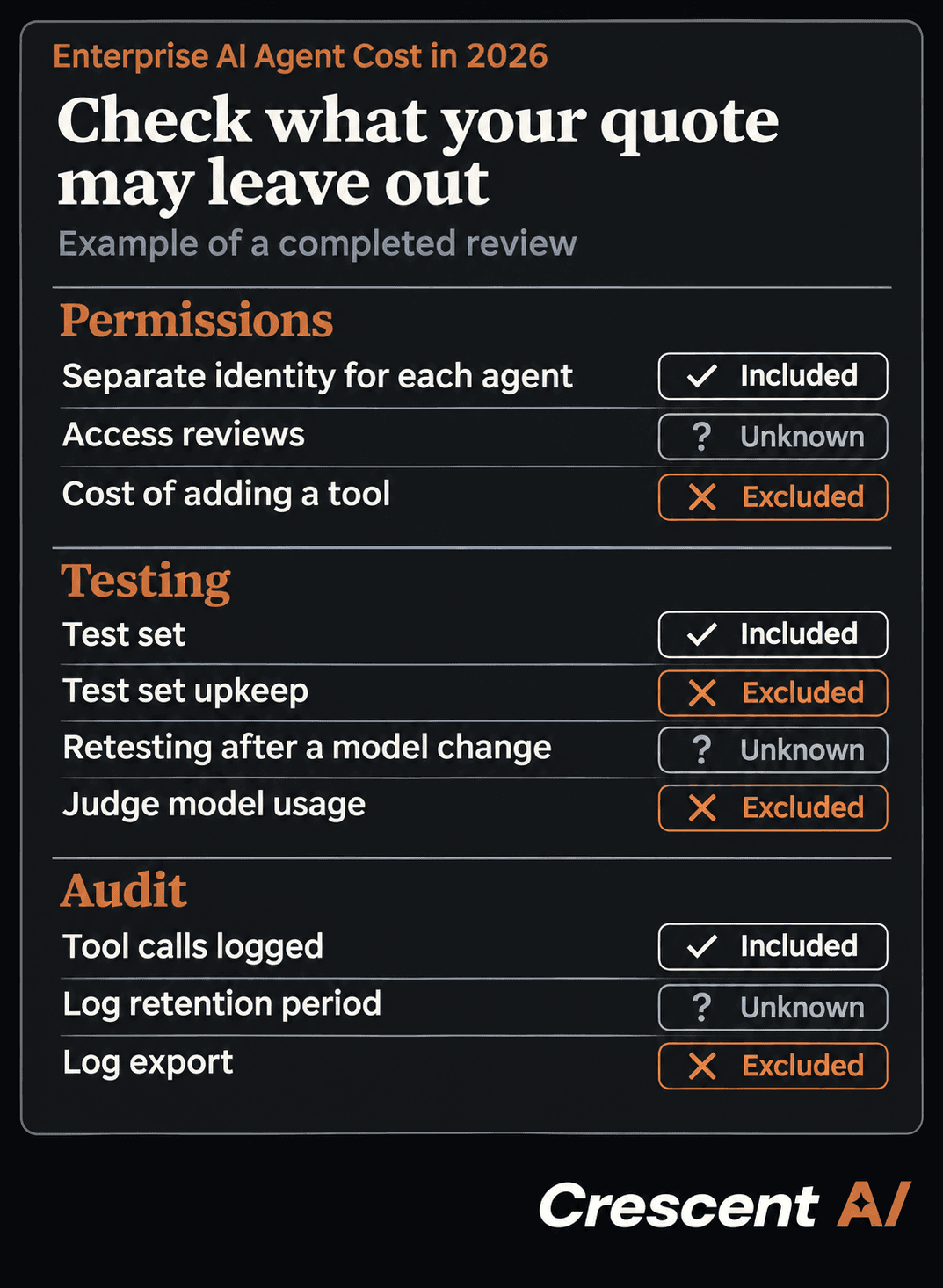
How Crescent AI handles these costs
We build permissions, testing and audit into the agent from the start, and we design the security model and test it before the agent touches production data. Here is our own answer to the checklist above.
| Cost line | In a Crescent AI project |
|---|---|
| Agent identities and scoped access | Included: minimum access for each tool, with a permission map. Separate identity checks for the person, agent and tool come from our AI security work. |
| Approval steps for risky actions | Included for anything that can't be undone |
| Access reviews after launch | Agreed during scoping |
| Test set and harness | Included: tests for success, failure and what the agent must never do, built from your real cases |
| Retesting after model, prompt or tool changes | Included: tests run before every change ships. We hand over the release check so your team can run it without us. |
| Judge model usage | Grading setup included, and checked against human judgment. Usage cost is agreed during scoping. |
| Tool-call logging and tracing | Included: a log of every decision and action, and an audit log for every tool |
| Log storage at your retention period | Agreed during scoping, based on your regulators and internal audit |
| Evidence reports for audits | Part of our AI governance work, mapped to NIST AI RMF or ISO 42001 |
For the refund agent, that would mean read access to orders, write access only to the refund action, and a person approving refunds above the limit. The test set would include awkward requests like the ones above, and the agent would have to pass it before we gave it more independence. Each refund would leave a log entry you could look up. This is still an illustration, not a client project.
When the project ends, you keep the full source code, the test suite, the permission map, a tested rollback and kill-switch, and the runbooks your team needs to run the agent without us.
On price, we don't use a flat rate, because cost follows scope: how many systems the agent connects to, how many decisions it makes without approval, how much testing and monitoring it needs, and whether your data needs cleanup first. We scope those in a discovery call and give a fixed estimate for the first phase, so you aren't signing for an open-ended build. Most engagements start with a short Architecture Sprint, and a Build Project then covers one production outcome with a defined scope. After launch, an optional monthly Production Retainer covers monitoring, model and prompt updates, incident response and evaluation. See how we work and how we approach AI agent development.
If you'd rather buy some of this yourself, here's what tools charge.
Tools and what they charge
Tools cover part of the cost, and staff time remains. These are list prices read from vendor pages on November 5, 2026. Plans differ and change, so this isn't a like-for-like comparison or a recommendation.
| Tool | Helps with | Free or entry | Paid |
|---|---|---|---|
| LangSmith[28] | Testing, tracing | $0 a seat, 5K traces a month | $39 a seat, 10K traces, then about $0.005 a trace |
| Langfuse | Testing, tracing | Free, 50K units a month | $199 and $2,499 tiers seen, $8 per extra 100K units |
| Braintrust | Testing, tracing | $0, 1 GB, 10K scores, 14-day retention | $249 a month, 5 GB, 50K scores, 30-day retention |
| Promptfoo[29] | Red teaming, testing | Open source, 10K probes a month | Enterprise custom |
| Microsoft Agent 365[30] | Identity, governance, oversight | None seen | $15 a user a month, or part of Microsoft 365 E7 at $99 |
| Amazon Bedrock AgentCore[31] | Identity, gateway | $200 in credits for new AWS customers | $0.010 per 1,000 token or API key requests, $0.005 per 1,000 gateway calls |
Even with the right tools, a few mistakes cost the most.
Mistakes to avoid
Most of these come from treating a quote as the full budget.
- Comparing quotes on price alone. Check what each one includes first.
- Letting an agent inherit a person's access. It may use permissions that person never touched.
- Treating testing as a launch task. Every model, prompt or tool change can restart it.
- Logging chat but not tool actions. You won't be able to show what the agent did or who authorized it.
- Relying on prompt instructions as the only control. The Replit incident shows why.
- Budgeting for the build with no running cost. Reviews, retests and log storage continue after launch.
Your next step depends on where you are.
What to do next
| Your situation | Next step |
|---|---|
| No quote yet | Run the seven-step estimate before talking to vendors, and use our readiness scorecard |
| You have a quote | Mark each line as included, excluded or unknown, then ask the vendor questions. Or send it to us for review |
| Agent already live | Check its access, its logs and when it was last retested, or get an AI engineering assessment |
Want a second opinion on your numbers?
Send us a quote from any vendor, or your project scope. We'll mark which permissions, testing and audit costs are covered, missing or unclear, and show you how we'd scope that work.
Need the agent built? We build production AI agents with these controls included, and we'll give you a fixed estimate for the first phase. Talk to us about your agent. For wider data, see our State of Agentic AI in Production 2026 report.
Sources
- [1] AI Agent Development Cost Guide in 2026 — Bacancy (vendor estimate)
- [2] State of AI in the Enterprise 2026, press release — Deloitte, survey ran August to September 2025
- [3] AI Agent Development Cost in 2026 — SparkoutTech (vendor estimate)
- [4] How Much Does It Cost to Build Enterprise AI Agents — Team 400 (vendor estimate)
- [5] The agentic AI cost iceberg — Dataiku
- [6] AI Agent Cost for Enterprise: A Line-Item Breakdown From Real Deployments — Codiste on LinkedIn (vendor estimate)
- [7] AI agent adoption research — SailPoint, May 2025
- [8] State of Agent Engineering — LangChain
- [9] Over 40% of agentic AI projects will be canceled by end of 2027 — Gartner, June 2025
- [10] AI agent wipes production database — eWeek, July 2025
- [11] Replit deletes production database — heise online, July 2025
- [12] Agent governance: how a global insurer built a registry — Business Technavigator, unnamed client, self-reported
- [13] Least privilege for AI agents: identity, access, and tool binding — Microsoft Security Blog, July 2026
- [14] Least Privilege Research Report 2026 — Oso and Cyera
- [15] 2026 Cost of a Data Breach findings — IBM
- [16] AI agent permission fatigue thread — Hacker News, May 2026
- [17] AI Agent Development Cost: Full Pricing and Guide for 2026 — Azilen (vendor estimate)
- [18] How Much Does It Cost to Build an AI Agent? — InterCode (vendor estimate)
- [19] Agent TCO 2026: Hidden Costs of Evals, Observability, Guardrails, and Human Review — CallSphere (vendor estimate)
- [20] AI evals are becoming the new compute bottleneck — EvalEval Coalition, April 2026
- [21] Article 19: Automatically generated logs — European Commission AI Act Service Desk
- [22] EU AI Omnibus enters into force — White & Case
- [23] Pricing — Braintrust, read November 5, 2026
- [24] Pricing — Langfuse, read November 5, 2026
- [25] Enterprise AI Agent Deployment for Regulated Industries — Codiste
- [26] Hidden costs of AI agent development — HyperSense (vendor estimate)
- [27] Cost of AI agents explained — EY
- [28] Plans and pricing — LangSmith, read November 5, 2026
- [29] Pricing — Promptfoo, read November 5, 2026
- [30] Microsoft Agent 365 — Microsoft, read November 5, 2026
- [31] Amazon Bedrock AgentCore pricing — AWS, read November 5, 2026